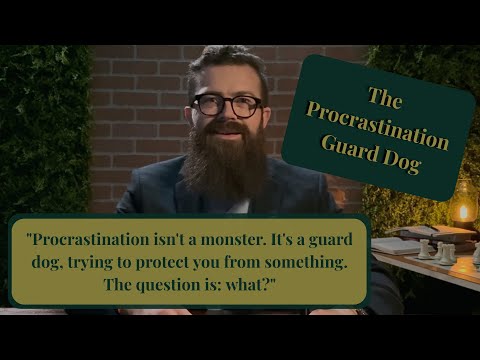
All Episodes 168: The Procrastination Guard Dog: Why You Stall and How to Make Peace With It
168: The Procrastination Guard Dog: Why You Stall and How to Make Peace With It
We all know the feeling: an important task looms, but you find yourself cleaning the fridge instead. What if procrastination isn't a character flaw, but a misguided protector? In this story-driven episode, we personify procrastination as a "guard dog"—a part of you that barks to shield you from fear, judgment, and the unknown. Learn how to recognize its alerts, understand what it's truly protecting you from, and discover three compassionate yet powerful strategies to gently step forward. This isn't a battle of willpower; it's a guide to making peace with your own mind so you can finally move from paralyzing delay to purposeful progress.
You have a task. It's important. Maybe it's a business plan, a difficult conversation, a creative project, or just getting yourself to the gym. You see it clear as day on your mental map—a landmark you desperately want to reach.
But between you and that landmark, the terrain feels treacherous. Unmapped. Overwhelming.
So what do you do?
You reorganize your bookshelf. You fall into a 45-minute rabbit hole about the history of the paperclip. You decide that right now is the perfect time to deep clean your fridge.
You're not lazy. You're busy. You're doing things. But in your gut, there's that low, quiet hum of unease because the things that really matter—the things you actually want—aren't getting done.
The landmark isn't getting any closer.
My friends, this is a story about procrastination. And here's the thing I've learned after years of wrestling with it: procrastination isn't about time management. It's about something much deeper.
The Guard Dog, Not the Monster
For years, I thought procrastination was the enemy. A monster to be slain with sheer willpower. Beat myself up enough, and surely I'd finally get moving.
But I was wrong.
Procrastination isn't a monster. It's more like a guard dog.
Think about a guard dog for a second. Its job is to stand at the gate and bark at threats. It doesn't analyze. It doesn't reason. It just reacts. Something unfamiliar, something challenging appears, and it sounds the alarm.
Danger. Danger. Don't proceed.
That's what's happening when you avoid that important task. Your mind is trying to protect you. The question is: from what?
What is the guard dog afraid of?
Is it the fear of failing and being judged? Is it the fear of succeeding and then having to live up to the expectation? Is it the fear that what you create won't be perfect? The sheer overwhelm of the unknown—staring at that blank page?
The guard dog's strategy is simple: distraction. Don't go toward that scary task, it says. Come over here. Check your email. Scroll social media. Clean something. These are safe. These are known. These are things you already know how to do.
Here's the tragedy, the irony: the very protection that guard dog is trying to provide becomes a prison.
Every time we listen, every time we give in, the shadow of procrastination grows a little bigger. The task becomes a little more monstrous. And slowly, subtly, we start to believe a story about ourselves.
I'm just a procrastinator.
That label sticks. And the dream stays on the map, forever in the distance, never coming any closer.
Turning on the Light
So how do we disarm this guard dog?
We start by not attacking it. We start by acknowledging that it's there.
The single most important moment in this entire story happens the moment you say out loud:
"I am procrastinating right now."
That's it. That's the pivot point.
Not "I'm so lazy." Not "I'm a mess." Just a simple observation: I'm avoiding the important thing.
That moment is you turning on the light in the room and looking at the shadow. The shadow is still there, yes. But now you can see its shape. Now you realize that you're the one holding the light. You're in charge.
And with that light on, you can ask the crucial question:
Guard dog, what are you really protecting me from?
Or in simpler terms: Why?
Why am I afraid of this task? What's holding me back? Is it the fear of a flawed first draft? Is it the fear of someone saying no? Is it the fear of looking foolish?
Name it. Speak it.
Bringing that fear from the murky unconscious into the clear light of your conscious mind strips away more than half its power. It's no longer a nameless terror. It's specific. It's manageable. And it's something you can actually deal with.
Three Strategies to Step Forward
Now comes the move. But you don't move by leaping the whole wall the guard dog is blocking. You move with cunning kindness.
Strategy #1: The Ludicrously Small First Step
What is the very simplest, easiest thing you can do to move toward that task?
Your task isn't to write a book. Your task is to open the document and write one terrible sentence.
Your task isn't to get in shape. Your task is to put on your running shoes and stand outside for 30 seconds.
Your task isn't to launch the business. Your task is to sketch one rough idea on a napkin.
This works because motivation follows action. That tiny completion—that feeling of "I did the thing"—creates a spark. It's proof to yourself that you can move forward. And momentum, once started, is much easier to sustain than to initiate.
Strategy #2: The Focused Sprint
Set a timer for 25 minutes. Tell yourself: for these 25 minutes, I will stay with this task. When the timer rings, I'm free.
This is the Pomodoro Technique, and it works because it reframes the task. You're not signing up for a life sentence. You're not committing to hours of suffering. You're agreeing to a brief, honorable tour of duty.
It trains your focus muscle in manageable reps. And somehow, knowing that freedom is only 25 minutes away makes the guard dog's bark a little quieter.
Strategy #3: Alliance
Tell one person. Share that ludicrously small first step and when you're going to do it.
An accountability partner turns the silent struggle into a shared journey. The guard dog's bark is much quieter when you're not alone in the room. When it's just you and that fear, the noise can be deafening. But when someone else knows? When someone else is quietly in your corner? The shadow shrinks.
You don't need a full cheering section. Just one person who will ask, "Hey, how did that one sentence go?"
The New Story
This is the shift. This is the new narrative.
You're not at war with yourself. You're not broken. You're not lazy.
You're a wise leader, understanding your own fears, guiding yourself forward with compassion and clear strategy.
Procrastination may always be there. That shadow may never fully disappear. But now you know its name. You know its game. And you have the light.
So here's your call to action for today. Pick one thing—one task you've been avoiding. Name the fear. Then take one ludicrously small step toward it. Not the whole project. Not the whole dream. Just one tiny movement.
Feel that spark.
That spark is you taking back the narrative. That spark is you proving that the dream on your map isn't just a distant landmark. It's a destination you are actively, courageously walking toward.
Join us weekly for deep, unfiltered conversations about personal development, leadership, productivity, and excellence. Each episode is crafted to help you take initiative and unlock your full potential — both personally and professionally
Billy Lahr returns to The Prestigious Initiative for a deeply honest conversation about living in the in-between. After 21 years as a teacher and dean, Billy stepped away from education—and four years later, he’s still experimenting, freelancing, promoting others, and wrestling with a question many high performers quietly carry: What if I don’t have a niche?
In this episode, Billy and Chris explore what it means to be a generalist in a specialist-driven world, the tension between quitting and gritting, and the emotional toll of constant experimentation and rejection. They talk about identity, generosity, self-promotion discomfort, and why wanting to see others win can be both a gift and a challenge. This is a real conversation about purpose, resilience, and staying in the arena when the path forward isn’t clear yet.
https://mindfulmidlifecrisis.systeme.io/jumpstartconvo
Do you feel like your inner world is a chaotic committee meeting? Where the voice of your inner critic, people-pleaser, and past critics all shout over each other every time you need to make a decision? In this impactful episode, we reframe that noise as a dysfunctional "Personal Board of Directors" you never chose. You'll learn how to conduct a quiet audit of these voices, kindly fire the unhelpful ones, and strategically hire a new, intentional council—including your inner "Strategic Architect" and "Compassionate Curator." Discover how to finally become the clear-headed CEO of your own mind and lead your life from a place of intention, not reaction.
Dr. Rhonda Parmer is on a mission to ignite a Leadership Alignment Revolution — to empower leaders to align themselves, their teams, their time, and their tasks without sacrificing well-being. In this episode of The Prestigious Initiative, Chris sits down with Rhonda to unpack her E.A.S.E.™ Framework (Engage, Align, Simplify, Empower) and explore how alignment — not busyness — is the true driver of leadership success. Drawing from her 30+ years leading schools, organizations, and executive teams, Rhonda offers real-world strategies for cutting through complexity, building confident teams, and creating cultures that thrive. Whether you’re navigating change, strengthening your leadership identity, or seeking sustainable performance without burnout, this conversation delivers actionable insights and mindset shifts that turn vision into measurable results. Get ready to rethink leadership and lead with greater clarity, confidence, and ease.
https:/rhondaparmer.com
https://www.linkedin.com/in/rhondaparmer112/